
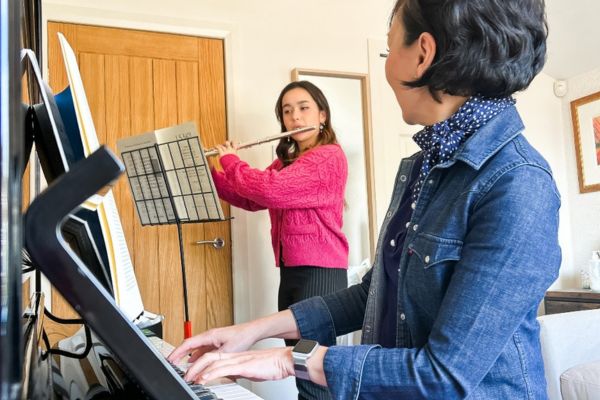
If you’re studying at Durham University and looking for a flute or piano teacher, you may be given a list of approved instrumental tutors.
Then comes the question:
How do you choose?
Do you choose the teacher who lives nearest?
Ask another student who they go to?
Choose someone because they have a space at the right time?
Or simply work your way down the list until somebody replies?
I’ve been teaching for around 40 years, including approximately 30 years teaching Durham University students, so I’ve seen many students face this decision.
My advice is simple: don’t feel that you have to choose immediately.
Contact two or three teachers who seem suitable and find out whether they offer a trial lesson.
Why have a trial music lesson?
A trial lesson isn't an audition.
You don't need to impress the teacher, and you don't need to arrive perfectly prepared.
It is a chance for you and the teacher to find out whether you work well together.
When a new flute or piano student comes to me for a trial lesson, one of the most important things we do is talk.
What are you hoping to achieve?
What do you enjoy playing?
Is there something about your playing that frustrates you?
Are you preparing for a university recital?
Would you like to improve your technique, sound, confidence or musical expression?
Perhaps you're not actually sure what you want yet.
That's perfectly fine too.
Part of my job as a teacher is helping you turn “I'd just like to get better” into some clear, achievable musical goals.
What should I bring to a trial flute or piano lesson?
Bring something you're currently playing.
It doesn't have to be your most impressive piece. In fact, something you're struggling with can often be much more useful.
A trial lesson gives me an opportunity to hear and see how you currently play and, importantly, to let you experience how I teach.
You should leave with a clearer idea of what you could work on and whether my approach feels right for you.
How do I know whether a music teacher is right for me?
Qualifications and experience matter, but so does the relationship between student and teacher.
Ask yourself after a trial lesson:
Did I understand what the teacher was asking me to do?
Did I feel comfortable asking questions?
Did the teacher listen to what I wanted?
Did I come away knowing what to work on next?
And perhaps most importantly:
Do I want to go back?
Learning an instrument is a partnership. You are likely to make better progress with a teacher whose explanations make sense to you and with whom you feel comfortable being curious, experimenting and occasionally getting things wrong.
Should I read reviews before choosing a music teacher?
Yes.
Reviews from existing and former students can give you a glimpse of something that a list of qualifications can't necessarily tell you: what is it actually like to be taught by this person?
Look beyond the star rating and read what students say.
Do they mention feeling more confident?
Do they talk about making progress?
Do they describe the lessons as clear, supportive or enjoyable?
Those comments can help you decide whether the teacher's approach might suit you.
Do Durham University students need a music lesson every week?
Not necessarily.
If you can have regular weekly lessons, you are likely to make faster and more consistent progress. Regular lessons give us a rhythm: learn, practise, review, adjust and move forward.
However, I know university students have different budgets, timetables and sources of funding.
If your funding only covers a limited number of lessons, we can spread them out. For example, you might choose to have a lesson every other week.
There isn't one timetable that suits everybody.
I offer a flexible lesson schedule, and we can discuss what will give you the most useful support within the time and budget available to you.
Can you help me prepare for my Durham University recital?
Yes. I've spent many years helping Durham University students prepare for performances and recitals.
Recital preparation isn't simply about getting all the notes right.
We can work on the areas that will make the biggest difference to your performance: technique, musical interpretation, tone, articulation, phrasing, confidence, repertoire and preparation.
As the recital approaches, lessons can also become much more performance-focused.
The aim isn't to turn you into somebody else's idea of a musician.
It's to help you communicate the music with greater skill and confidence.
What if I don't know what my musical goals are?
That's more common than you might think.
You might arrive saying:
“I want to improve my flute playing.”
Or:
“I've reached a bit of a plateau.”
Or simply:
“I know this could sound better, but I don't know what to do.”
That's enough to start with.
You don't need to work everything out before you contact a teacher.
Start with your musical wishes.
We can turn those wishes into clearer goals together.
What if I'm nervous about having my first lesson?
Please don't spend the week beforehand frantically practising!
Come as you are.
Sometimes students arrive having practised consistently. Sometimes university life has taken over and their instrument has barely left its case.
Both give me useful information.
A good lesson isn't a test of how well you've practised. It's an opportunity to discover what will help you move forward from where you are today.
Flute and piano lessons for Durham University students
If you're choosing a flute or piano teacher from the Durham University instrumental tutor list, take your time.
Contact a few teachers.
Read their reviews.
Ask questions.
And, where possible, have a trial lesson before committing to a series of lessons.
I've taught flute and piano for around 40 years and have worked with Durham University students for approximately 30 years, including helping students prepare for university recitals.
My lessons are centred around the individual student: where you are now, where you'd like your music to go, and what will help you get there.
Ready to find out whether we're a good fit?
You can start with a 30-minute trial flute or piano lesson.
Bring some music you're currently working on and any questions you have. We'll talk about your playing, your musical wishes and what you'd like to achieve.
You can also read reviews from my students before booking. They'll give you another perspective on what it's like to learn with me.
Then, if we're a good fit, we can decide together what happens next.
Your first decision doesn't have to be how many lessons to book.
It can simply be:
“What would I love to be able to do with my music?”